jeudi 20 octobre 2011

Natural and unnatural languages

Natural and unnatural languages


I personally like naturalistic languages, so my invented languages are full of irregularities, quirky lexical derivations, and interesting idioms.
It's easier, no doubt, to create a "logical" language, and desirable if you want to create an auxiliary interlanguage, à la Esperanto. The danger here is a) creating a system so pristine, so abstract, that it's also impossible to learn; or b) not noticing when you reproduce some illogicality present in the models you're using. Ask me about the irregularities of Esperanto sometime.

Worksheet: Lesson I.B, Vowels

Worksheet: Lesson I.B, Vowels

Part I:

This works like your first assignment (which, if you haven't yet completed that one, please do it too :-) : For each of the vowels listed below, list three words in which that sound can be heard. (This may differ between dialects, so not everyone may agree on answers...that's ok.)

Example: /a/ __father, starve, cot___


1. /i/ ________________
2. /I/ ________________
3. /e/ ________________
4. /E/ ________________
5. /&/ ________________
6. /@/ ________________
7. /V/ ________________
8. /u/ ________________
9. /U/ ________________
10. /o/ ________________
11. /O/ ________________
12. /a/ ________________


If you forget what these symbols stand for, see the table in the lesson.

Part 2:

This combines the vowel symbols and the consonants. (Consult the table of consonant symbols here if you need them.) Within the /slashes/ is the phonetic transcription of an English word, using the symbols we have learned. Figure out what that word is - sound it out, and type it in!

Example: /sIk@mOr skajwOk@r/ __Sycamore Skywalker__
Example: /brajt/ __bright__
Example: /izi/ __easy__


1. /teb@l/ ___________________
2. /mOrnin/ ___________________
3. /fjuC@r/ ___________________
4. /rajt/ ___________________ (multiple answers possible! give at least one)
5. /siN/ ___________________
6. /sajfajvajn/ ___________________
7. /leNgwIJ/ ___________________
8. /fojl/ ___________________
9. /fawl/ ___________________
10. /vajl/ ___________________
11. /klawd sIdi/ ___________________
12. /kIks/ ___________________
13. /Int@rnEt/ ___________________
14. /Vp/ ___________________
15. /b&nd/ ___________________
16. /luk/ ___________________
17. /lUk/ ___________________
18. /Tro/ ___________________
19. /kat/ ___________________
20. /kOt/ ___________________ (19 and 20 are a tricky minimal pair...if you don't recognize the difference, that's ok, we'll go over it later...)
21. /bOd@l/ ___________________
22. /priC/ ___________________
23. /rajz/ ___________________
24. /hElo/ ___________________
25. /helo/ ___________________
26. /r&D@r/ ___________________
27. /redar/ ___________________
28. /&Z@r/ ___________________
29. /frES/ ___________________
30. /jVN/ ___________________
31. /hu/ ___________________
32. /@we/ ___________________

Bonus points: Translate your SFV alias into phonetic transcription! Example: Sycamore Skywalker = /sIk@mOr skajwOk@r/


Okay, pencils down, let's see what you came up with!

Note that one problem with this is going to be that the capital "I" used for the high front lax unrounded vowel in "sit" is going to look just like the lowercase "l" used for the consonant in "look". Hopefully you will be able to tell them apart by context...

Worksheet: Lesson I.A: Consonants


For each of the consonants listed below, list three words in which that sound can be found.
Example: k__kitten,_cat,_actor__
  1. p_________________________
  2. t_________________________
  3. k_________________________
  4. b_________________________
  5. d_________________________
  6. g_________________________
  7. m_________________________
  8. n_________________________
  9. N_________________________
  10. f_________________________
  11. s_________________________
  12. h_________________________
  13. v_________________________
  14. z_________________________
  15. l_________________________
  16. T_________________________
  17. C_________________________
  18. r_________________________
  19. D_________________________
  20. J_________________________
  21. j_________________________
  22. S_________________________
  23. Z_________________________
  24. w_________________________
  25. ?_________________________

Lesson I.B: Vowels

Lesson I.B: Vowels


This should be the last HUGE lesson we’ll have – after this things shouldn’t take as long to explain. :-)

If you haven’t yet read through the lesson on Consonants (Lesson I, Part A), please go back and read it before this lesson. Those of you that have read it might want to review it, considering how long ago that was....Be sure to review the chart of ASCII equivalents for the consonants, also.

Vowels


You’ll recall that consonants are grouped according to certain “dimensions”: Place of articulation, manner of articulation, etc. Vowels can also be grouped according to the dimensions along which they vary. The Language Construction Kit lists these dimensions as Height, Frontness, Roundedness, Length, Nasalization, and Tenseness (How to Create a Language lists a few other dimensions as well, but we won’t go into those). The first three are the most important for “defining” a vowel; for example, if I mention the “high front unrounded” vowel, you’d all know I was talking about the “long e” sound in the word “sea”, right? :-) Well, once this lesson is over, you’d know that. You’d also know how to tell me what vowel you’re thinking of by defining those three features. So let’s start by learning what these features mean.

Height


How high is the tongue – i.e., how close to the roof of the mouth? This is usually divided into three positions, quite creatively named “High,” “Mid,” and “Low.” :-) Say “Bee” or “You.” That is High. Say “Cat” or  “Father.” That is Low. Say “Say” or “Show.” That is Mid.

Frontness


What part of the tongue is involved; that is, what part is raised or lowered? Is it the part close to the front of the mouth, the back, or the center? These are ever-so-cleverly classified as “Front,” “Central,” and “Back.” Front vowels are heard in “Bee,” “Snake,” and “Cat.” Back vowels are heard in “You,” “Show,” and “Father.” English has only two (some would lump them together and say only one) Mid vowels. Essentially, it’s the same sound but is classified as to whether it’s used in a stressed or unstressed syllable. For stressed syllables, the Mid vowel is that which you hear in “Shut Up.” The same sound, in an unstressed syllable, is the famous “Schwa Sound,” which all English vowels very sneakily mutate into whenever you don’t bother to put syllable stress on them. It’s the sound of the first syllable in “about,” for one example.

Roundedness


In pronouncing these vowels, your tongue can’t do it all alone; the position of the lips is also a consideration. Compare “See” and “Sue.” Both have High vowels; “See” has a Front vowel and “Sue” a back vowel. What else differentiates them? It’s the lip-rounding; for “See” you pull the corners of your mouth back tightly while for “Sue” you round them into a nice little “O”. In English, curiously, only our back vowels are rounded, but front vowels can be rounded as well, and you’ll hear rounded front vowels in words like French “tu, feu” and German “du, hören.” (Respectively, that’s a High Front Rounded followed by a Mid Front Rounded in each language.) You can also have un-round back vowels, although English doesn’t. (Check out the reading assignments at the beginning of the lesson for other examples of languages that use sounds not found in English.)

Tenseness


English vowels often come in pairs: a tense version and a lax version. The difference is in the tension of the tongue muscle; there’s also sometimes a slight difference in height or length of the vowel. Tense vowels are higher, sometimes longer, and more tense than lax vowels. It’s easiest to see this contrast by looking at the vowels: “Seat” is tense, “Sit” is lax. “Boot” is tense, “Put” is lax. “Rake” is tense, “Wreck” is lax.

Length


In some languages vowels contrast between “Long” and “Short” based on the amount of TIME spent on them; generally a Long vowel is pronounced twice as long as a Short vowel. Length is a feature in Latin, Greek, Sanskrit, and Old English, for example. Some languages even have more than two degrees of length! In notation, long vowels can be differentiated from short vowels by doubling them (/aa/ for a long vowel, /a/ for a short vowel) or by writing a colon (:) after them (/i:/ for a long vowel, /i/ for a short vowel).

Nasalization: Anytime a vowel is followed by a nasal consonant (n, m, N), it tends to change its sound a little. Some languages, notably French, use the nasal-sounding vowel without the nasal consonant (in French, though the consonant is written, it’s not pronounced; just the nasalized vowel is pronounced). You can hear nasalization in the difference between “Pit” and “Pin” or “Wet” and “When” or “Cat” and “Can” – the nasalized vowel tends to raise a little.


Oh look! More unfamiliar phonetic symbols in the diagram! Don’t worry…we’ll explain those now. Here’s the IPA’s chart of all humanly possible vowels:
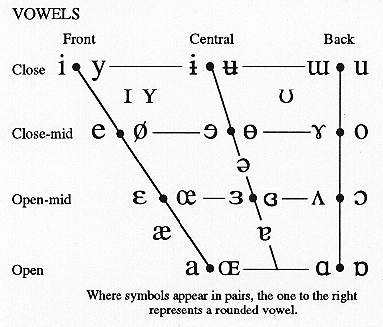
Not all of these are found in English, of course. In the diagram you can see the ones that are – you can also click on them to hear how they sound! Or hear them in these words:


// in “seat” and “free” – the High Front Tense Unrounded vowel.
// in “bit” and “flip” – the High Front Lax Unrounded vowel.
// in “bait” and “gate” (note that the diagram has got the example words mixed up between this and //) – the Mid Front Tense Unrounded vowel.
// (called “epsilon”) in “bet” and “get” – the Mid Front Lax Unrounded vowel.
// (called “ash”) in “cat” and “can” – the Low Front Unrounded vowel. (Neither lax nor tense)
// (called “schwa”) in unstressed syllables such as “about” and “Rosa” – the Mid Central vowel.
// in stressed syllables such as “but” and “up” – the Mid Central vowel.
// in “boot” and “shoe” (the diagram has examples for this mixed up with //, too...) – the High Back Tense Rounded vowel.
// (called “upsilon”) in “book” and “cook” – the High Back Lax Rounded vowel.
// in “boat” and “coat” – the Mid Back Tense Rounded vowel.
// (called “open o” or “backwards c”) in “ought” and “caught” – the Mid Back Lax Rounded vowel.
// (called "lowercase a") in “father” and “cot” – the Low Central vowel.
There's also // (called "script a"), the Low Back vowel, but English doesn't really distinguish between this and // - although there's no reason why our language couldn't use both vowels as separate phonemes.


Here, now, is our chart of all the vowels with their IPA symbol as in the graphic above and the diagram, an example of their usage, description of their features, and most importantly, the way we’ll write that sound in this class.

IPA As heard in Description> ASCII symbol we will use
free high front tense unrounded: "lower-case i" i
French "tu (not in English) high front tense rounded: "lower-case y" y
pit high front lax unrounded: "small capital i" I
Not found in English...anyone know an example in another language? It's the rounded version of . high front lax rounded: "small capital y" Y
late mid front tense unrounded: "lower-case e" e
German "hören" mid front tense rounded: "slashed o" %
bet mid front lax unrounded: "epsilon" E
Not found in English...anyone know an example in another language? It's the rounded version of . mid front lax rounded: "o-e ligature" *
cat low front: "ash" &
father low central unrounded: "lower-case a" a
Not found in English...anyone know an example in another language? It's the rounded version of . low central rounded: "small capital o-e ligature" #
about unstressed mid central: "schwa" @
up stressed mid central: "inverted v" V
Luke high back tense rounded: "lower-case u" u
look high back lax rounded: "upsilon" U
blow mid back tense rounded: "lower-case o" o
caught mid back lax rounded: "open o" or "inverted c" O
We won't worry about the unrounded back vowels for now, unless we end up using them in TGL.

Your next assignment will follow shortly...

LESSON 1.A.4: Multidimensional Consonants

Multidimensional Consonants (LESSON 1.A.4)

As you learned in the textbook assignment for Lesson 1, sounds vary along dimensions. Now that we've learned symbols for the consonants of English, we're going to take a closer look at the dimensions by which these consonants are defined.

Degree of closure

  • Stops, also called Plosives, where air is totally stopped momentarily
  • Fricatives, where air is not stopped totally but obstructed so as to cause friction
  • Approximants, where the airflow is only slightly affected, including the Glides and Laterals - Consonants that border on being vowels

Place of Articulation

  • Labial - lips
  • Labio-dental - lips and teeth
  • Dental - teeth and tongue
  • Alveolar - right behind the teeth
  • Palato-alveolar - further back from the teeth
  • Palatal - top of the palate
  • Velar - back of the mouth
  • Uvular - further back than velar
  • Glottal - back in the throat (glottis

Voicing

Do the vocal cords vibrate when the sound is produced? For voiced sounds, they do; for voiceless sounds they do not. (You can tell by feeling your throat for the vibration.)

Nasalisation

Does the air flow out through the nose when the sound is produced? English has three nasal stops, where airflow is stopped in the mouth but not the nose: /m/, /n/, /N/.

Aspiration

Is the sound pronounced with an accompanying puff of air? Place your hand in front of your mouth. (Pretend you're hiding a yawn.) Say "pit". Say "bit". See the difference? If you're a native speaker of English you sure will, because in English, the voiceless stops (of which /p/ is one) are always aspirated when they're the initial consonant. Say "pit" again, then say "spit". See the difference? You're more likely to spit on your listeners when saying pit than spit, because the s before p in spit makes the p unaspirated. Why don't we aspirate the /b/ in bit? Mainly because it's a voiced consonant, meaning the vocal cords vibrate, and to do so they must close - which means they can't let through that puff of air that follows the /p/! It's not impossible to aspirate a voiced consonant, though. Sanskrit (and proto-Indo-European) had aspirated voiced stops: bh, dh, etc., as in "Mahabharata" (great book, by the way...).

Palatalization

Is the mid part of the tongue raised to the palate when the sound is pronounced? As your textbook explains, palatalized consonants sound something like the original consonant plus a /j/ sound (remember that /j/ is the symbol for what English speakers usually spell with a y, as in "you"...). Russian has a series of palatalized consonants, Spanish has two, French has one, etc., as shown in your textbook.

Glottalization

Does the glottis (throat) close when the sound is pronounced? To produce a glottalized consonant you have to pronounce the consonant plus a glottal stop at the same time, then release them together. I'm still trying to figure out how that should sound...

Some linguistic terms we need to know:

phones

The possible sounds in a language

phonemes

Sounds a language can distinguish between; for example, aspirated and unaspirated /p/ are the same phoneme in English, because we don't distinguish between them to show different meanings. In other words, we have /phIt/ (the h means the /p/ is aspirated, and /I/ is the symbol for the i sound in pit), but if someone pronounced it /pIt/ without the aspiration, we wouldn't recognize that as a different word with a different meaning. If however they said /bIt/, voicing the first consonant, we would recognize it as a different word, because we have a voiced/unvoiced contrast in English but not an aspirated/unaspirated contrast. Some languages do not have the voiced/unvoiced contrast so /pIt/ and /bIt/ would be the same word to them because /p/ and /b/ are the same phoneme. And that brings us to...

Allophones

When two phones represent the same phoneme in a language, we call those phones allophones. In English /p/ and /ph/ are allophones. In a language that doesn't have voiced/unvoiced contrasts, /p/ and /b/ would be allophones.

Now, the reason why we're learned about all these dimensions - you may have guessed from the previous few paragraphs. Each language has its own set of possible sounds - phones - and its own system of phonemes and the possible allophones for those phonemes. Languages are all limited, however - some have more sounds than others, but not all the possible sounds. Languages also tend to use sounds according to their series, as you see them in the IPA chart. That is to say, if you find one uvular sound in a language, chances are you'll find another. If there's one nasal sound in a language, there's probably a series of them. Not necessarily the whole series of possible nasals - there are seven, after all, and as we know, English has only three. But more than one - sounds are not hermits. If you find a certain contrast in the language, it will probably apply througout series: for example, if you have a nasalized/unnasalized contrast for your stops, the contrast will apply to all the stops (in English, this means that since we have the stops /p/ and /b/, /t/ and /d/, and /k/ and /g/, we have the nasal stops /m/, /n/, and /N/. If we had palatal or uvular stops in English, we'd probably have palatal and uvular nasal stops too. Another example is voicing - since English contrasts between voiced and unvoiced consonants, you find both a voiced and an unvoiced consonant wherever both are possible throughout the chart of English consonants.

What we will need to do for TGL is to define the phones and phonemes of the language, which means deciding which series are represented (do TGL speakers use africates or not? do they have velar sounds?) and which contrasts are present (do we contrast on voicing? on nasalization? on palatalization?) We'll vote on all that stuff later; for now I'll let all this sink in while I get a practice exercise ready.

Lesson 1.A.3 More about Non-English Consonants


More about Non-English Consonants

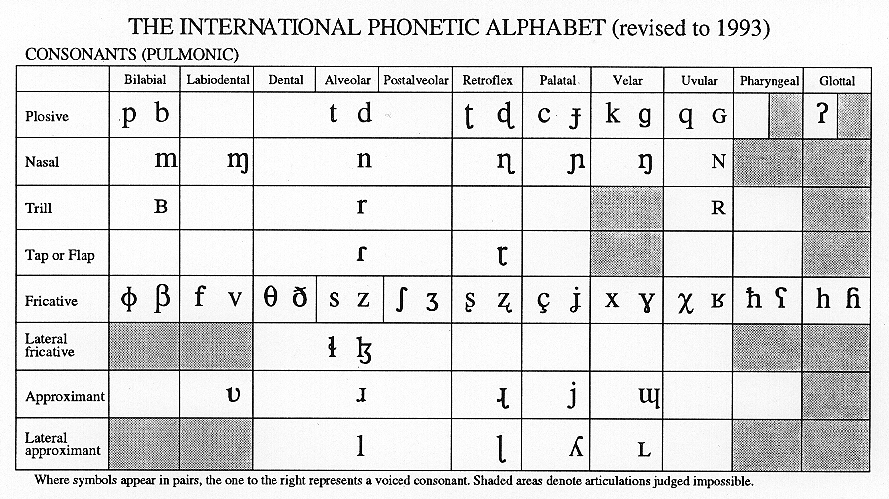
Take another look at the IPA chart of consonants:

Look for the "series" of consonants - that is, the rows and columns that show how sounds are related. What series have the fewest "holes" - sounds theoretically possible but not actually used? You'll probably notice right away the Fricative series. Remember that these are sounds made by constricting the air flow, though not stopping it, to create friction. This Manner of articulation can occur at any of the Places of articulation, as you see on the chart. Most languages do not, however, use all the Fricatives. English uses /f/, /v/, /T/, /D/, /s/, /z/, /S/, /Z/, and /h/. We don't use the bilabial fricative (to form it, pronounce a /p/ or /b/ and then pronounce it again without bringing your lips closed - like the difference between a /t/ and a /s/ or /d/ and /z/. Nor do we use the retroflex, palatal, velar, uvular, or pharyngeal fricatives. The velar fricative /x/ is found in many languages - the ch in German, Greek, and Scots. The uvular fricative that looks like an upside down R is the French "r". (One of them, anyway.) The bilabial fricative is found in Spanish, I believe - I think the voiced one (symbolized by the Greek letter beta - the B with a tail :-) is in words like "bebe".

Another series that is quite "full" is the Alveolar series, those sounds whose Place of articulation is the hard ridge right behind the teeth. English makes use of most of these, excluding the lateral fricatives (I'm not sure what these sounds are - should be an /l/ sound fricativized, meaning with friction added - it may be the "ll" sound in Welsh, but I'm not certain) and - in American English at least - the trill. (American r's are the upside down r you see - the approximant. Some varieties use a retroflex r instead.)

Since these two series are "full", they might be a good place to find non-English consonants to use in our language. We must take into account what languages TGL is descended from, though...if English is its ancestor, you might find mostly English consonants in TGL. Or you might find that there had been a sound shift somewhere over the centuries - perhaps some English stops had been replaced with their corresponding fricatives...or certain English nasal sounds separated to include other nasal sounds not found in English...who knows?

Another interesting series of consonants, which isn't shown on the IPA chart above (because if you're using the IPA alphabet, you write them with two symbols), is the Africates. English has only two, /C/ and /J/. Africates are easy to figure out: Take a Fricative sound (of which, as we know, there are many), and instead of just pronouncing it as a steady friction-producing obstruction of the air stream, STOP the air stream for just a moment before the friction starts. In other words, it's a stop and a fricative combined. /C/ is /t/ and /S/ combined: you start with the /t/ and flow right into the /S/. /J/ is a combination of /d/ and /Z/. (In the IPA alphabet, /C/ is written /tS/ [not t and S, actually, but the IPA symbols for them...you know what I mean...) and /J/ is /dZ/, that's why there are no IPA symbols for Africates - they can all be written as combinations.) Can we make other Africates from the Fricatives and Stops on the chart? You bet! For example, German has /ts/ - the z in Zehn - and /pf/ - as in Pfennig. /ts/ is also found in Japanese: tsunami.

Lesson I.A.2: Consonants

Here's a chart, borrowed from the International Phonetic Association, that shows all the humanly possible consonants (not including clicks and such...) arranged by place and manner of articulation:
You'll notice there are many more consonants there than in our previous chart of American English consonants. You've also probably noticed that many of the symbols are NOT what you saw on that last chart. :-) Our next step is to learn those symbols, which make up the International Phonetic Alphabet. For more information on the IPA and some useful charts (many of which I'm borrowing for this lesson), check out the International Phonetic Association's web site. After you've learned the IPA symbols, we'll have to learn ASCII versions of them so we can write about sounds without having to use all sorts of fonts or graphics...
Note: You may wish to print out or bookmark this chart for reference...

IPA Symbols for American English Consonants

IPA As found in Description ASCII symbol we will use
pill Voiceless bilabial stop p
till Voiceless alveolar stop t
kill Voiceless velar stop k
bill Voiced bilabial stop b
dill Voiced alveolar stop d
gill Voiced velar stop g
mill Nasal Bilabial Stop m
nil Nasal Alveolar Stop n
ring Nasal Velar Stop N
feel Voiceless Labiodental Fricative f
seal Voiceless Alveolar Fricative s
heal Voiceless Glottal Fricative h
veal Voiced Labiodental Fricative v
zeal Voiced Alveolar Fricative z
thigh Voiceless Dental Fricative T
thy Voiced Dental Fricative D
shell Voiceless Palatal (Postalveolar) Fricative S
azure Voiced Palatal (Postalveolar) Fricative Z
chill Voiceless Palatal Africate C
jill Voiced Palatal Africate J
leaf Alveolar Lateral Liquid (Approximant) l
American r reef Alveolar Liquid (Approximant) r - untrilled, r[trl] - trilled (trilled r)
you Palatal Glide (Approximant) j
witch Voiced Labial-Velar Glide (Approximant) w
which Voiceless Labial-Velar Glide (Approximant) w[vls]
uh-oh Glottal Stop ?
For the other consonants on the chart, you can work from the place and manner of articulation to figure out what they sound like. Even though they're not found in English we could certainly use them in TGL if we like. Here's some common ones:
IPA As found in Description ASCII symbol we will use
Bach Voiceless Velar Fricative x
brun or rouge Uvular Fricative R
If there are any other non-English consonants you'd like to incorporate into TGL, we can come up with ASCII symbols for them also.
Related Posts Plugin for WordPress, Blogger...